Thursday, 25 February 2016

Jackson Pollock and Action Painting Workshop

Jackson Pollock is an American, abstract expressionist artist who is known for creating the most iconic abstract styles in the history of modern art. During his early life, Pollock experienced Native American Culture which led to influences and similarities through his artwork. When he moved to New York in 1929 he was also inspired and influenced by Mexican Mural Painters and works by Picasso. His involvement with gestural painting was inspired partly by the sand paintings of the American Indians and partly by surrealism. Jackson started to create techniques of dripping trails of paint onto a canvas laid flat on the floor which was named “action painting”. In 1940 he introduced this technique because he was aware of human vulnerability after World War II and he wanted to express his concerns through abstract art and “action painting”. To create the action paintings, canvases were set on the floor or laid out against a wall, rather than being fixed onto an easel. Then Jackson used the style where he would allow the paint to drip from the can at different angles to create effects onto the canvas. Instead of using a brush, he would add depth to his images using knives, trowel or sticks. The pieces reflect the artist’s emotions, expression and moods when he created them which makes the artwork individual and unique.

https://www.youtube.com/watch?v=lfwUxQrDGqw- This Video presents Jackson Pollock creating an "Action Piece" painting.
Jackson Pollock in action


Pollock's work


On Thursday 23rd of February we completed an “Action Painting” workshop inspired by the works of Jackson Pollock. To start the task we collected a variety of paints and materials to create a Jackson Pollock “Action Painting” style piece. Once the collected the materials I needed, I started to set up the environment for where the action piece was going to be create. In order to film and document my action-painting a clear piece of Perspex was used so that the camera could be place underneath to capture the paint being placed onto the surface. By placing the camera underneath the Perspex it gave a special effect as the video appears to be covered in paint. Also, by filming the development of the action-painting, it relates to Jackson Pollock’s work because he built up his pieces with layers of paint and tools. I decided to use primary colours to create my action painting piece because they are bold colours that are eye-catching and relate to Jackson Pollock’s work as he used the same colours for his work. I also used primary colours because they would stand out on the Perspex when the filming it. To build up the piece I created, I used different techniques to place the paint onto paper which gave a unique effect like Jackson Pollock’s work. Once I completed the action-painting the final outcome was presented on the Perspex.




Glossary Terms

Kinetic Art-a form of art that depends on movement for its effect. The term was coined by Naum Gabo and Antoine Pevsner in 1920 and is associated with the work of Alexander Calder.

Zoetrope-a 19th-century optical toy consisting of a cylinder with a series of pictures on the inner surface that, when viewed through slits with the cylinder rotating, give an impression of continuous motion.

Stop Frame Animation- is animation that is captured one frame at time, with physical objects that are moved between frames. When you play back the sequence of images rapidly, it creates the illusion of movement.

Time Lapse-denoting the photographic technique of taking a sequence of frames at set intervals to record changes that take place slowly over time. When the frames are shown at normal speed the action seems much faster.

Time based art-Contemporary art work that can include video, film, slide, audio of computer based technology's as well as traditional processes of image making.

Flip Book animation- A flip book or flick book is a book with a series of pictures that vary gradually from one page to the next, so that when the pages are turned rapidly, the pictures appear to animate by simulating motion or some other change.

Reportage drawing

To start the task I collected A3 sized pieces of paper and a variety of materials such as: colour pencils, pencils, felt tips, coloured markers and oil pestles, which I worked with to create an reportage drawing. Firstly, we created quick sketches and focused on drawing people and subjects in the room. We were given different tasks to create 5 different sketches in the time slot we were given and used the different materials for each individual drawing. These tasks allowed us to show development and progression throughout the task. Also by drawing people allowed us to focus of facial features and how peoples faces are different. By using different materials gave me a little push to be more creative and adventurous, also to develop my work. This task help me find out that quick sketches weren't my forty and that I am more of a perfectionist. However, after developing different skills at each sketch, I learnt that creating quick sketches had to be simple minded when presenting features. At the end of each sketch it really did make me think that the abstract and quick sketching isn't my thing and that I am more of a perfectionist.


Stopmotion

Here is mine and Maisy's stop motion video of a flower slower growing. We decided to show a flower in the process of growth. By taking pictures of the flower at each stage and slightly changing the image each time and then taking another image. We produced this using white plain paper and colour marker pens. Then by adding all the images together it all combined the clips to look like they're linked and the plants growing each time. I put the animation together using an app on Maisy's phone called Gif Creator. I enjoyed creating this and editing it to my liking by increasing and decreasing the speed and cropping the images to link together.
First Stage
Last stage

Types of animation


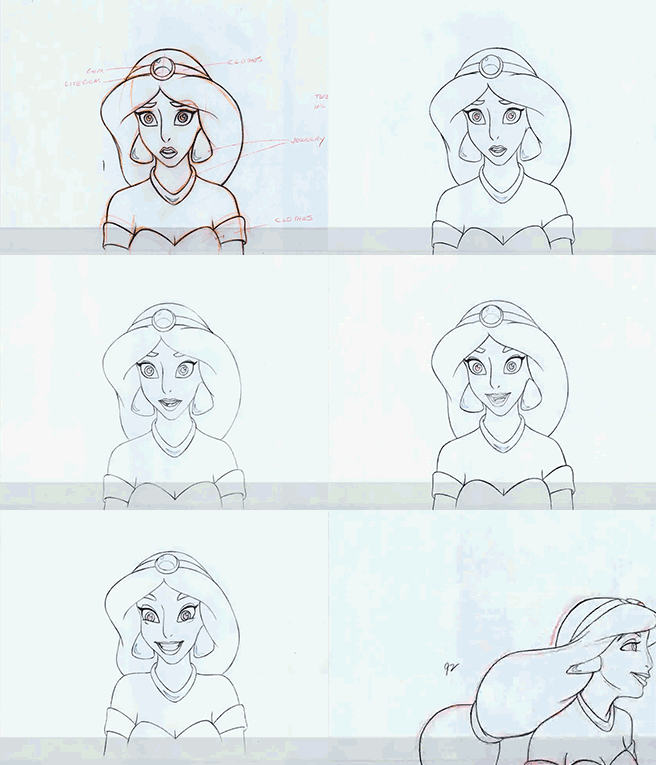
Traditional animation or Classical 2D animation
Traditional animation involves animators drawing by hand for each and every frame.
https://www.youtube.com/watch?v=M2ORkIrHUbg
Traditional Animation Movies : Snow White and the Seven Dwarfs, Peter Pan, and Sleeping Beauty, Aladdin and Lady and the tramp.


What is traditional hand drawn animation?
Traditional animation (or classical animation, cel animation or hand-drawn animation) is an animation technique where each frame is drawn by hand. The technique was the dominant form of animation in cinema until the advent of computer animation.

How many frames per second is a cartoon?
Moving characters are often shot "on twos", that is to say, one drawing is shown for every two frames of film (which usually runs at 24 frames per second), meaning there are only 12 drawings per second. Even though the image update rate is low, the fluidity is satisfactory for most subjects.

Zoetrope Animation 
Zoetrope is one of several animation toys which were invented in the 19th century, as people experimented with ways to make moving pictures. It was invented in 1834 by William George Horner, and is one of the early forms of animations. Some still images are drawn on a drum and when turned in a circular way, you have an illusion of movement. The visual effect created by a zoetrope is still used today to create animated GIFs.

Movies that used a Zoetrope?
Toystory, All Things Fall and My neighbour totoro.


Flip book Animation 
Even before the time of computers, animation was very much in practice. Artists used to carry a small flip book or flick book and draw a series of images, with little variation to the pictures, so when the book is flicked rapidly, you can see the series of images in a fluid motion, trying to show a scene. Flipbook animation is one of the oldest but fascinating kind of animation.
Since 2007, Walt Disney Animation Studios has started its films with a production logo that initially evokes a flip book. It starts with a view of an empty page of paper, then as the pages start to turn, details are drawn in to reveal Mickey Mouse in Steamboat Willie.

Flip books are now largely considered a toy or novelty for children, and were once a common "prize" in cereal and Cracker Jack boxes. However, in addition to their role in the birth of cinema, they have also been an effective promotional tool since their creation for such decidedly adult products as automobiles and cigarettes. They continue to be used in marketing today, as well as in art and published photographic collections. Vintage flip books are popular among collectors, and especially rare ones from the late 19th to early 20th century have been known to fetch thousands of dollars in sales and auctions.

Clay Animation
Clay animation or claymation is one of many forms of stop motion animation. Each animated piece, either character or background, is "deformable"—made of a malleable substance, usually Plasticine clay.
Movies involving Claymation?
Wallace and gromit, Boxtrolls, toys in the attic, Paranorma, fantastic mr fox, chicken run and Frankenweenie. 


Wednesday, 24 February 2016

Bill Viola

Bill Viola
Viola was born 25th January, 1951(aged 65)and is a American video artist and contemporary video artist whose artistic expression depends upon electronic, sound, and image technology in New Media. He is the main voice in the establishment of video as a virtual form of contemporary art. Bills work includes videotapes, architectural video installations and total environments that include video and sound. The video work has expanded over the years through technology, content and historical terms. As a student he was involved with video and electronic media and since 1970, Violas video art has been seen all over the world.
Dreamers

Bill Violas work focuses on human experiences, cultures and religion because his video communicate to a wide audience and allows them to experience the work directly in a personal way. He has extended his work to Eastern and Western cultures and he has studied cultures such as Zen Buddhism in Japan and fire-walking ritual among Hindu communities. The themes of spirituality has been presented through human condition and in an abstract presentation.

The Dreamers is an environment piece that contains a series of seven plasma screens which includes individuals of different ages who are underwater. The individuals are lying still with their eyes shut, with a sound of the water filling the room. A calming appearance is given to the visitor as the individuals appear to be at peace.
blood


water and fire

Bill Viola believes that young people are in an “interesting place right now” and they are “talking about something inside themselves that they understand because of the digital age and the use of their IPad and IPod”. Over the years, Bill has expanded the use of technology and his team are always updating digitally as modern technology is increasing faster. In Bill Violas early work, he worked with one medium and produced videos and sound through portable video cameras that focused him as the subject. Today he hires commissioned actors and uses digital flat-panel plasma screens that produces bright 35mmm film at 210 frames per second. Bill edits colour and adjusts videos
Recently, at the Yorkshire Sculpture Park, the Underground Gallery was transformed into a dark maze to present the work of Bill Viola. The audience experienced the controlled environment of image and sound that related to the pieces such as water droplets. The exhibition was based on the themes of life, death, love and spirituality. It was such a great piece of work to witness, I had a quick glance round the gallery and it was so fascinating to see repeating movement and sound create so much emotion.